

























































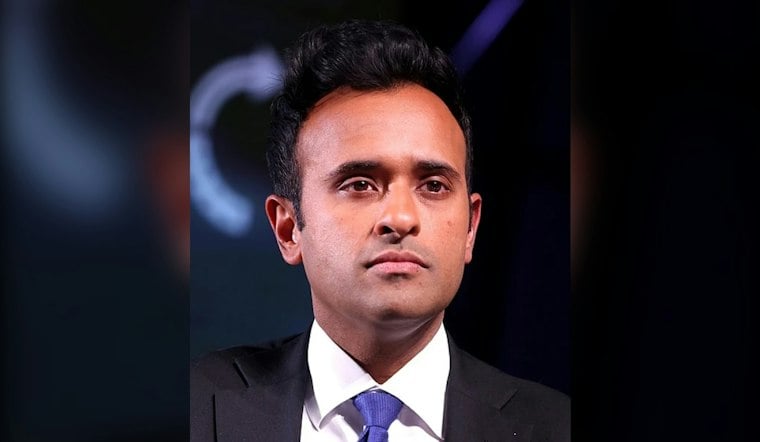
An ad backing Republican gubernatorial candidate Vivek Ramaswamy links Democratic opponent Amy Acton’s data-center policies to investments listed in her financial disclosure. The records show holdings in companies associated with the industry, but that is not the same as a direct investment in a data center. The ad also uses footage of Acton discussing campaign spending and political advertising to suggest she was addressing data centers.
What the Evidence Shows
A Cleveland.com review by reporter Karan Singh found that the ad groups operating data centers with projects that are only planned, and does not establish that Acton invested directly in any data center. It also found that the footage of Acton was from remarks criticizing Ramaswamy's campaign spending and political advertising, not comments about data centers. The ad presents that unrelated footage as evidence of her position on the industry.
Acton's financial disclosure did list shares in Microsoft, according to the fact-check. A separate News 5 Cleveland investigation identified Acton holdings in companies associated with data centers based on that disclosure, and found her 2025 filing included Microsoft, Alphabet, Meta, Iron Mountain and several semiconductor companies, per the Dayton Daily News. Iron Mountain operates a 44,000-square-foot, 1.4-megawatt data center in Miamisburg, near Dayton, the same News 5 Cleveland report noted.
Acton Says She Sold Her Stocks Months Ago
Acton wrote an October guest column saying she sold all of her individual stocks in April and pledged not to invest in or possess them as governor, according to the Cleveland.com fact-check. Her campaign separately told News 5 Cleveland that she does not own any individual stocks, and as governor she will not invest in or possess individual stocks. The Dayton Daily News reported that the April 2026 sale moved her IRA investments into exchange-traded and other diversified funds.
Ramaswamy's own financial disclosure tells a more layered story. The News 5 Cleveland investigation documented a far more extensive tech portfolio for him, with more than a dozen holdings in companies affiliated with data centers, including Microsoft, Amazon and NVIDIA. He holds NVIDIA stock both individually and through the Strive U.S. Semiconductor ETF, which he co-founded, the same investigation found, and a 2023 federal tax filing showed a Microsoft holding worth up to $5 million. His April 2026 disclosure listed holdings in Prologis — the company developing a data center project in Trenton — along with Apple, Microsoft and NVIDIA, per the Dayton Daily News.
Ramaswamy has said he was unaware of some specific investments, suggesting they might be held through index funds or represent, in his words, “a speck of dust in a portfolio of biotech and other holdings,” according to Ideastream Public Media. The fact-check notes the ad suggests Acton compromised her political independence for financial gain, but the evidence in the investigation it cites does not show that her investments influenced her policy positions.
Microsoft's Ohio Build-Out
Microsoft has confirmed data center projects in New Albany, Heath and Hebron, Ohio, which are expected to become operational by the end of 2029, per the fact-check. Microsoft's own community page states the company is building data centers in those three Ohio communities. That timeline follows a reversal: Microsoft said in April 2025 it would not move forward at that time with planned Licking County sites, according to NBC4 Columbus, before later breaking ground on the Heath and Hebron facilities.
Where the Candidates Actually Stand
Despite the dueling investment questions, both candidates back new restrictions on the data-center industry, though their plans diverge on scope. Acton announced support on July 27 for a conditional moratorium on new data-center development unless projects meet requirements, the Dayton Daily News reported, and per WTAP, her plan would require developers to cover 100% of their own utility costs, build exclusively with union labor, operate with full transparency and meet Ohio's existing air- and water-quality standards.
Ramaswamy's platform, announced in August, would prohibit new data centers from coming to the state until companies pay the electric bills for the communities they're in, according to News 5 Cleveland. His Ohioans-First Data Center Pledge, outlined by WTAP, would require nearby residents to receive free electricity from developers, require new facilities to pay full property taxes with no abatements, and set strict air- and water-quality standards with brownfield sites prioritized. Both frontrunners are adamant about pausing the data-center boom, as the Ohio Capital Journal put it, even as their investment histories draw scrutiny.
Utility Charges and Construction Timelines
The Public Utilities Commission of Ohio directed AEP Ohio in July 2025 to file updated data-center tariffs and lift its moratorium on connecting new data centers, according to the PUCO. In April 2026, the commission said its AEP Ohio rate-case order requires a minimum monthly customer charge for new data-center customers. That charge sets a minimum payment, though the information cited here does not quantify how much cost it would prevent from shifting to other ratepayers. On Microsoft’s Heath project, a March 2026 company update said early site preparation was expected to be substantially complete by year-end, while a timeline for vertical construction had not yet been determined. The update does not specify water or power arrangements, so it does not resolve those infrastructure questions.
Big Money in the Closing Stretch
The ad arrives amid a heavily funded final stretch of the race. Ideastream Public Media reported that political advertising trackers found $79.2 million more had been spent on ads for Ramaswamy than on ads for Acton, and that V-PAC, an independent expenditure group backed by financiers and technology executives including Elon Musk, was spending an estimated $45 million to elect Ramaswamy, including a $9 million data-center advertising buy. Amid that spending surge, the Cook Political Report and Sabato's Crystal Ball recently moved the Ohio governor's race from toss-up to leans Democrat, according to the same report.
Under Ohio Ethics Commission rules, a financial disclosure statement is meant to report certain personal financial interests and fiduciary relationships from the preceding calendar year, with Friday, May 15, 2026, serving as the general filing deadline for most filers covering calendar year 2025. Those disclosures are the paper trail both campaigns are now fighting over in the final days before voters decide the race.





